Mitsubishi FX3G ASCII Ethernet (Gen1)
Review the following information for setting up and configuring the Mitsubishi FX3G ASCII Ethernet (Gen1) driver.
Belden Horizon Data Operations Compatible Series
Compatibility parameter | Compatible items |
|---|---|
Driver type | Ethernet |
Validated devices/series | MELSEC-F |
To set up and configure this device in Belden Horizon Data Operations, you will need to do the following:
- Step 1: Set up and Configure the PLC Device
- Step 2: Set up the PLC Device in Belden Horizon Data Operations DeviceHub
- Step 3: Configure the List of Registers
Step 1: Set up and Configure the PLC Device
If the device is configured for Ethernet access, find its network parameters. Otherwise, follow the steps below.
To configure your device:
Note down the following information and refer to it as needed.
Device: Mitsubishi FX3GE-24M
Communication I/F: Ethernet. Refer to the following figure.
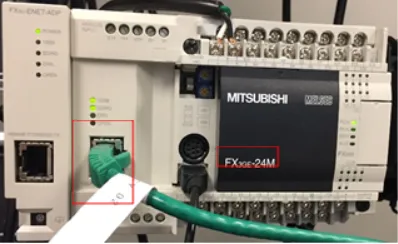 Reference image of device
- Connect the device to your pc using USB and launch the GX Works 2 v1.560J software.
- Click Online > Read from PLC.
- Select PLC series.
- Set up the connection.
- Click Connection Test.
- From the Navigation panel, click Connection Destination > connection1.
- Click Connection Test.
Step 2: Set up the PLC Device in Belden Horizon Data Operations DeviceHub
Configure the following parameters when you Connect a Device with this driver. Update default values to the specific setup of your device.
Parameter | Value |
|---|---|
Type | Mitsubishi |
Driver | Mitsubishi FX3G ASCII (Gen1) |
Network Address | The device address you defined in Step 1 |
Port | 5001 |
Step 3: Configure the List of Registers
When you Add Tags to the connected device, refer to the following register table and tag parameters.
Register Table
Name | Value Type | Address Format | Min Address | Max Address | Description |
|---|---|---|---|---|---|
X | bit | DDD | 0 | 255 | Input Relay |
Y | bit | DDD | 0 | 255 | Output Relay |
M | bit | DDDD | 0 | 7999 | Internal Relay |
T | bit | DDD | 0 | 511 | Timer Contacts |
C | bit | DDD | 0 | 255 | Counter Contacts |
SM | bit | DDDD | 8000 | 8511 | Source Int. Relays |
S | bit | DDDD | 0 | 4095 | Step Relays |
R | word | DDDDD | 0 | 32767 | File Register |
SD | word | DDDD | 8000 | 8511 | Service Data Register |
CV2 | word | DDD | 200 | 255 | Counter Value |
D | word | DDDD | 0 | 7999 | Data Registers |
CV | word | DDD | 0 | 199 | Counter Value |
TV | word | DDD | 0 | 511 | Timer Value |
Tag Parameters
- Name: Select a register name from the drop-down list. The available options depend on the names in the register table.
- Value Type: Select a data type from the drop-down list. The available options depend on the register name selected.
- Polling Interval: Enter a value in seconds. This determines how often the tag should poll the register for data.
- Tag Name: Enter a name for the tag.
- Description (Optional): Enter a description for the tag.
- Address: Enter a tag address. The value must in the decimal format, within the allowed min/max range. Omit the leading zeros. The device might use the decimal (D), hexadecimal (H), or octal (O) address format. See the Register Table at the bottom of the dialog box. For Bit tags, append the bit address without the bit separator. The lowercase letters in the address format indicate how many digits you should enter in the Bit address.
- Tag Formula: Enter a formula for the tag to process the generated data. Two variables are permitted: value (current tag value) and timestamp (current tag UNIX time in milliseconds). The following math functions are available:
- sin
- cos
- sqrt
- tan
- power: power(x) performs the operation 10^x.
- log: log(x) is the natural logarithm (the logarithm is in base e).
- exp: exp(x) performs the operation e^x.
- Only Publish on Change of Value: Select the checkbox to only publish NATS messages when the value parameter changes to a new value. Change of Value only applies to boolean, numeric (such as int or float), and simple string data types. It does not apply to complex types, such as JSON or array. Poll-once topics will not be affected by Change of Value settings. These topics will still only see a single message.
- Meta Data: Metadata summarizes basic information about data. This feature allows you to define key-value pair data for the device output payload later on. Metadata can then be used to find, use, and reuse particular instances of data.
Note: If you use special characters in meta data key names, the special characters are replaced with underscore characters in the payload. This can cause two key names to be combined into one. For example, configuring the key names a**b and a&&b will cause only one key name to be created (a__b).